Nirma and Wheel: a low priced challenger and the leader’s reply
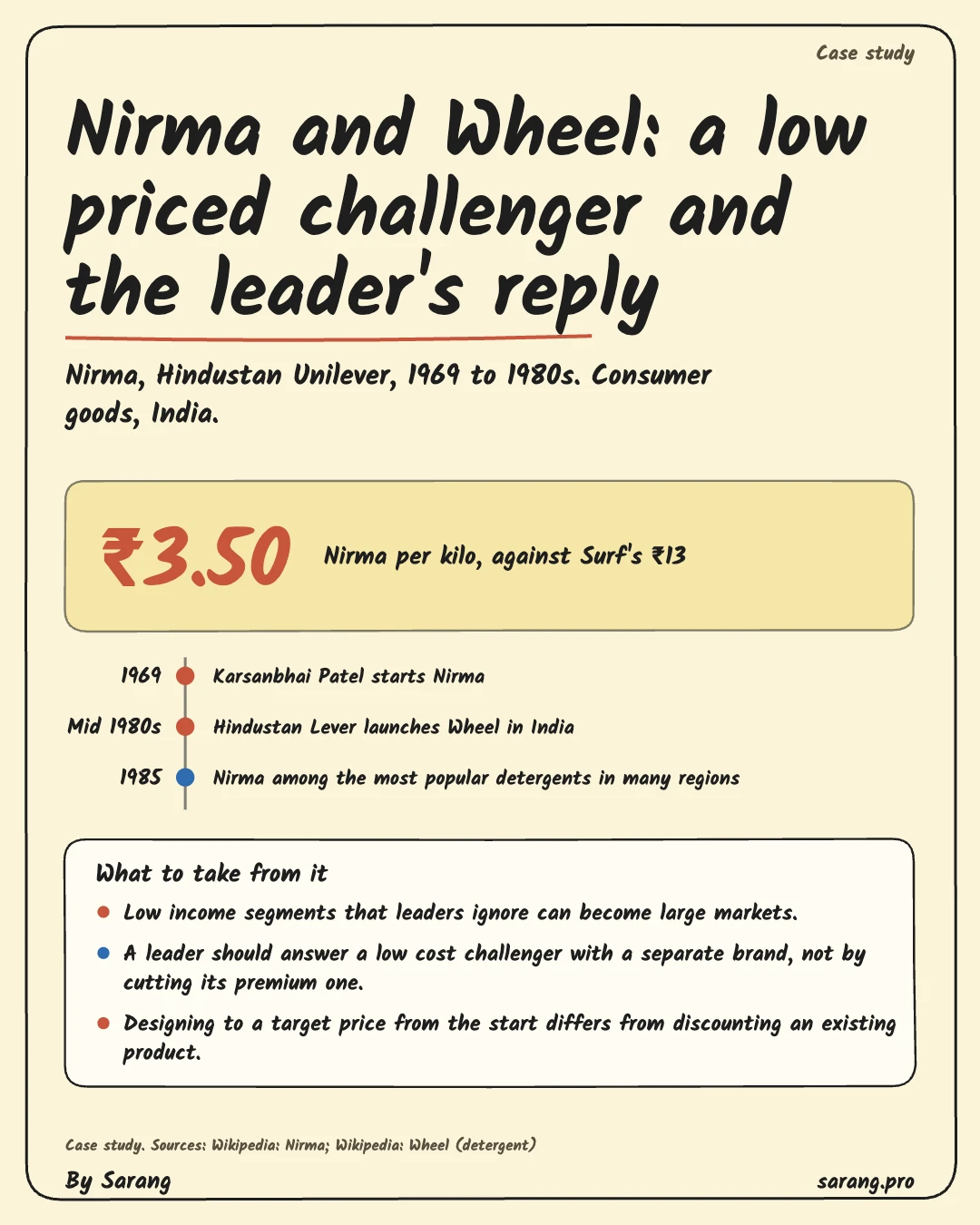
Nirma sold detergent at around a quarter of Surf's price and was reported to hold about 60 per cent of the market by 1988, until Hindustan Lever answered with Wheel.
- Reported Nirma price per kilo, against Rs 13 to Rs 21 for Surf
- Rs 3 to Rs 7
- Nirma share in 1985 in one account
- 58.1%
- Nirma volume at about 60 per cent share
- 1.72 lakh tonnes
- Share of Nirma raw materials made in-house
- 90%
The situation
By the mid-1980s Hindustan Lever Limited (HLL), the Indian arm of Unilever, had a problem that no amount of brand heritage could fix. Its premium washing powder Surf had been the leading detergent in the country, and a small Gujarat business called Nirma was taking its customers at a fraction of the price. The sources give different prices, but the pattern is the same: Nirma sold at roughly a quarter of Surf’s price or less, with figures reported as Rs 3 against Rs 13, Rs 3.5 against Rs 13 or Rs 15, and Rs 7 against Rs 21 per kilo.
The market numbers reported for the period are dramatic. By 1985 one account has Surf down to 8.4 per cent of the market and Nirma at 58.1 per cent. Another says Nirma overtook Surf in 1985 and held about 60 per cent by 1988, selling more than 1.72 lakh tonnes. A third says only that Nirma reached at least 38 per cent against HLL’s 31 per cent in the 1980s. These accounts disagree, and none comes from an audited source, so the safe reading is that Nirma moved from nothing to the largest share of detergent volume in about fifteen years.
HLL’s reply was Wheel, a low-priced powder made and sold in a different way from anything else in its range. The reply worked. Reports say that by 1989 Wheel was India’s second-largest detergent brand, and that by 2002 HLL’s share had risen to 38 per cent while Nirma’s had fallen from 61 per cent to the same figure. This case follows both sides: how a low-price challenger beat a leader, and how the leader changed its own operating model to answer it.
Background
Hindustan Lever and Surf
HLL was the Indian subsidiary of Unilever and, by the time of the case studies written about it, India’s largest consumer goods company. One account puts its turnover at over Rs 11,000 crore, with three million retail outlets and 36,000 employees, though that figure belongs to a later date than the 1980s. Surf, launched in 1959, was India’s first washing powder. It had a smart blue box, elaborate graphics and a premium price, and it sold to households that could afford a branded product. HLL’s decades of advertising, distribution and brand building sat behind it.
Karsanbhai Patel and the first Nirma
Karsanbhai Patel was a science graduate and farmer’s son from Gujarat. Value Research says that he worked as a chemist for the Gujarat government’s Department of Mining and Geology when he started Nirma in 1969. StartupTalky adds that he had earlier worked as a lab technician at a Lalbhai group mill in Ahmedabad. He developed a detergent using soda ash and other materials, made it at the back of his home in Khokhra near Ahmedabad, and sold it door to door. On a daily bicycle trip of about 15 kilometres he sold 15 to 20 packets, according to StartupTalky. He left his job after about three years to work on Nirma full time. The brand was named after his daughter Nirupama, who died in a car accident.
A different cost base
Value Research reports that Patel priced his product at roughly a quarter of the equivalent competing product, though it says the exact figures are fuzzy. It also reports that about 90 per cent of Nirma’s raw materials were made in-house, that the group became one of India’s largest soda ash manufacturers, and that the early products were made without electric power, which kept Nirma in the small-scale category and qualified it for initial excise concessions. Another source describes Nirma’s early manufacturing as low-cost hand production with few fixed costs, with stockists handling transport and delivery. The low price was therefore not a promotion. It rested on a cost structure that a premium brand with large factories and a big sales force could not copy quickly.
The industry
A divided market
Before Nirma, detergent in India was bought mainly by wealthier households, while others used crude washing bars, according to Value Research. Industry accounts divide the market into economy, mid-range and premium segments. One case study summary says that mass-market detergents grew to 80 per cent of volume and 68 per cent of value, up from 70 per cent when Surf entered the market. If that is right, the bulk of the market lay where HLL had not been selling.
Distribution and retail
Selling a low-priced powder to small shops meant working on thin margins and using credit. StartupTalky reports that retailers were at first reluctant to stock Nirma, that Patel extended credit, and that late payments led to losses and the recall of unsold packets. Value Research notes a related episode: Nirma withdrew its stock from the market for more than a month before a 1982 jingle campaign, and the resulting consumer demand pushed retailers to stock the product. Whether this was a deliberate tactic or a forced pause, the outcome was that demand pulled the product through the shops.
Advertising
Nirma’s advertisements were more playful than the way laundry was usually shown. Retail4Growth credits a signature campaign to Purnima Advertising and says the jingle and a montage of housewives ran unchanged for 12 to 15 years. StartupTalky says Nirma spent 3 to 4 per cent of revenue on marketing, against 6 to 8 per cent for competitors. HLL ran Surf with a character called Lalitaji, played by Kavita Chaudhary according to one account, who argued that quality mattered more than price. Nirma answered with Deepikaji.
The competitive field
Besides HLL, other players entered over time. Procter and Gamble brought Ariel to India in 1991 and Tide in 2000, according to an HLL case summary. A brand called Ghari, from Rohit Surfactants, began in 1987 or 1988 and is reported to have overtaken both Nirma and Wheel later.
The decision
HLL had to decide how to deal with a competitor that attacked at the bottom of the market. The records available do not include internal documents, so the options below are the obvious alternatives, framed as such. Where accounts name actions HLL took, those are covered in the next section.
Option one: ignore the low end
HLL could have kept Surf at its premium price and let Nirma have the low end. One account says HLL first saw Nirma as a threat only to the bottom of the market and then judged the middle and lower-income segments worth defending. Ignoring Nirma would protect margins on Surf, and it would also leave HLL without a share of the volume that was growing fastest.
Option two: cut the price of Surf
The second option was to match Nirma’s price with Surf itself. An account on a business blog says that Surf’s team formed a group called C.R.I.S.P., for Cost Reduction in Surf Prices, which led to the effort known as Operation STING. A second source says that Surf’s price was not reduced and that HLL instead presented Surf as the smarter choice. Cutting the price of a premium brand risks damaging the brand’s image and the profit of every pack already sold at the higher price.
Option three: attack with a new brand and a new model
The third option was a separate low-priced brand with its own costs. That is the route HLL took with Wheel. It would not confuse the Surf customer, and it could be run with a leaner cost base. It required HLL to accept that its usual operating model, with fixed prices, its own factories and a layered distribution network, did not fit the low end of the market.
What was at stake
The stake was the company’s position in its largest home care category. One account says HLL lost ground in volume in 1987 and regained it in value by 1990. Another quotes Dhaval Buch, later Unilever’s chief procurement officer, who said that HLL’s scale had created what he called “intellectual arrogance”. The decision therefore involved changing habits as well as products.
What they did
Operation STING
HLL’s response is widely described as Operation STING, short for Strategy to Inhibit Nirma’s Growth. The accounts differ on its timing. One places it in the 1970s and early 1980s, another links it to the Wheel launch in 1988. A third says it was led by HLL’s chairman at the time, Dr Ashok Ganguly, and aimed to change the business model, not only to launch a product. The research and development team was asked to produce a low-cost detergent that whitened better than Nirma without its side effects, since Nirma’s high soda ash content was blamed for wear, tear and itching.
Wheel: test market, launch and cost model
One account says Wheel passed a test market in 1987 and launched in 1988, priced slightly above Nirma. Other sources give 1986 or 1987 for the launch, and one notes that an earlier Wheel bar was scrapped for poor sales. Whatever the exact date, the way Wheel was made and sold is consistent across accounts. Production moved to third-party, semi-automated units near raw material sources. HLL bypassed its clearing and forwarding agents and sold directly to stockists, and one account says it later outsourced production and distribution to Stepan Chemicals, a subsidiary in Punjab. The formula used less oil, because rural consumers often washed clothes in rivers. Wheel was run from Chandigarh, away from HLL’s Mumbai base, and used pricing that varied by state, which departed from HLL’s fixed price portfolio.
Advertising built on Nirma’s weakness
Wheel’s campaign targeted the burning of hands that Nirma’s soda ash caused, with a line that translates roughly as: I asked for cleanliness, and you gave me burning hands. HLL also produced a jingle called “Dekho Dekh Dekh” in response to Nirma’s own musical advertising, and it considered but did not use a line for Surf that it judged harmful to the brand’s long-term value.
Other brands at the low end
HLL also tried Sunlight, a white detergent powder priced the same as Nirma and aimed at the eastern and southern states where Nirma was weaker. One account says Sunlight had little success outside eastern India. Later HLL relaunched Rin and the Wheel bar in about 1989, and after Procter and Gamble’s Ariel arrived in the early 1990s it launched Surf Ultra in February 1992 and cut development time from two years to four months.
What happened
Wheel’s rise
The reports agree that Wheel grew very fast. By 1989 it was India’s second-largest detergent brand, and by 1990 it was larger than any other HLL brand. Retail4Growth says Wheel reached the top of the market in the early 2000s, positioned as a gentler product at a price close to Nirma’s.
| Measure | Reported figure | Account |
|---|---|---|
| Surf share in 1985 | 8.4 per cent | Expert Mumbai blog |
| Nirma share in 1985 | 58.1 per cent | Expert Mumbai blog |
| Nirma share in 1988 | About 60 per cent, over 1.72 lakh tonnes | StartupTalky and Retail4Growth |
| HLL share, 1987 to 2002 | 7 per cent to 38 per cent | Expert Mumbai blog |
| Nirma share, 1987 to 2002 | 61 per cent to 38 per cent | Expert Mumbai blog |
| Nirma share by 2010 to 2011 | About 10 per cent | Expert Mumbai blog; SlideShare summary |
The figures come from secondary summaries and are not audited. They may use different definitions of the market and different measures, such as volume against value.
The challenger’s fall
Nirma’s later decline is attributed in StartupTalky to three causes: a lack of innovation, a low-price image that came to be seen as inferior as HLL and Procter and Gamble moved into premium products, and a lack of focus after costly ventures into other segments such as toothpaste and hair care. The same source says that input costs, including linear alkyl benzene and palm oil, rose while Nirma avoided raising prices for a long time, and it quotes a Mumbai brokerage analyst saying rivals spread across price points while Nirma stayed purely value for money. The source says the share price and profitability fell continuously from April 2006.
A third challenger
Wheel itself was later overtaken. Retail4Growth reports that Ghari, which began in 1987 and came into its own in 1995, overtook both Nirma and Wheel in the mid to late 2000s with a price below Nirma’s. By 2014 estimates put Nirma at around 10 per cent in a market of about 400 detergent brands, and another account says Ghari then held about 9 per cent. So the low-price segment produced successive challengers, and each beat the one before it on price.
Other views
HLL insiders
The most revealing criticism comes from inside HLL. Dhaval Buch’s remark about intellectual arrogance suggests that the company’s size delayed its response. The speed of the later response, with Surf Ultra developed in four months against two years, shows what changed once the company accepted that it was challenged.
Analysts of Nirma
Analysts quoted by StartupTalky blame Nirma’s own choices for its decline: a failure to premiumise, new products that did not differentiate, and a reluctance to raise prices when costs rose. A Retail4Growth piece, by contrast, quotes the consultant Harish Bijoor saying that dropping the Nirma Girl from advertising would be a loss, which points to a brand that still carried some emotional weight.
Limits of the evidence
The sources used for this case are mostly business blogs, a newspaper-style trade site, a slide deck derived from a university case study, and a Business Standard report. They disagree on prices, on the launch dates of Wheel and Ghari, and on market shares. Some figures appear to belong to different dates and may use different market definitions. The reader should take the pattern from this case, a very large low-price challenger and a leader that changed its operating model, and not any single percentage.
Reading it through a framework
Disruptive innovation
In Clayton Christensen’s account, a disruptive entrant begins with a cheaper product that serves overlooked customers and then moves upward. Nirma fits the first half closely. It served households that were not buying branded powders, it used a cost base that the leader could not match, and it gained volume that HLL had treated as marginal. It did not move far upmarket, and that is the reason its position later weakened: when HLL and Procter and Gamble premiumised, Nirma stayed at the bottom. HLL’s response with Wheel also follows the framework, because the textbook answer to disruption is to create a separate unit with its own cost structure, not to ask the main business to compete on its own terms. Wheel was run from Chandigarh, with outsourced production and state pricing.
Value chain and cost structure
A value chain view asks where each firm creates cost and value. Nirma controlled raw materials, with about 90 per cent made in-house and its own soda ash, used manual production and small-scale tax treatment, and spent a smaller share of revenue on marketing. HLL’s chain had expensive stages for a low-price product: company factories, a layered distribution network, and agents. Wheel’s changes were targeted at those stages. Third-party manufacturing near raw materials, direct supply to stockists and lighter formulation removed cost where it did not matter to the customer. The result suggests that the real contest was between two cost structures, not between two brand names.
Since then
The detergent market moved on from the Nirma and Wheel contest. Business Standard reported in February 2023 that Surf Excel became the first Indian home and personal care brand to cross US$1 billion in annual sales, with 2022 sales of Rs 8,200 crore, according to an Economic Times report. It said Surf Excel, Rin and Sunlight together held 43 per cent of India’s detergent market, HUL’s highest share in more than a decade, and that Surf Excel’s sales rose 32 per cent, helped by growing preference for Rs 10 packets. The same report says Nirma displaced HUL from the top spot in 1985, that Ghari took the top spot in 2012, and that Surf Excel has been the leader for the past three years.
HUL’s executive director for home care credited premiumisation through liquid detergents and fabric conditioners. The sequence in that article is the main lesson of the later history. The premium brand, once beaten at the bottom of the market, recovered by moving the market upwards while still selling small low-price packs. Nirma, in the 2014 account, kept a share of around 10 per cent, and its founder’s family business had by then moved into other areas, with Value Research mentioning a US$1.4 billion bid for the cement assets of Lafarge India. The date of that bid is not given in the opened article.
What to take from it
- A cost structure built around a low price can beat an established brand, because the leader may not be able to match the price without damaging its own margins.
- A leader’s best answer to a low-price challenger can be a separate brand with a separate operating model, as Wheel’s outsourced production, direct supply and state pricing show.
- A challenger that stays only at the low end becomes exposed when rivals move upmarket and the low price begins to signal poor quality.
- Leaders are slowed by their own scale and habits, and an executive’s remark about intellectual arrogance describes a danger that sits inside the company.
- Market share numbers in popular business accounts vary widely, so the careful reader compares sources and uses the pattern, not a single figure.
Questions to think about
- If you had led Surf in 1985, would you have cut the price, launched a second brand or ignored the low end, and what would you have needed to know first?
- How much of Nirma’s early success belonged to its price and how much to its distribution and advertising?
- What could Nirma have done to move up without losing its low-price customers?
- Why might a leader find it easier to launch a separate brand with a different cost structure than to change its main business?
Concepts at work
This case shows low-end disruption, cost structure and the value chain, and brand positioning. Explore them in Insights.
Written from the public sources listed below. Figures are as those sources report them.
Framework
Timeline
- 1959Surf launched as India's first washing powder
- 1969Karsanbhai Patel starts Nirma
- 1982Nirma jingle campaign follows a withdrawal of stock
- 1985Nirma overtakes Surf, in several accounts
- 1987Wheel test market, in one account
- 1988Wheel launched under Operation STING, in most accounts
- 1989Wheel is the second-largest detergent brand
- Feb 1992HLL launches Surf Ultra after Ariel arrives
- 2002HLL and Nirma level at 38 per cent each, in one account
- 2012Ghari takes the top spot
- 2022Surf Excel sales reach Rs 8,200 crore
- Feb 2023Business Standard reports Surf Excel crossing US$1 billion
Recap cards
Tap a card to check yourself.
Sources and credits
- Value Research: Entrepreneurship lessons from Karsanbhai Patel
- StartupTalky: The rise and fall of Nirma
- Unstop: Newbie to Numero Uno, Nirma's story of emerging as the successful underdog
- Retail4Growth: 40 years ago and now, Nirma girl endears, but brand's seen better days
- Only Kutts: Soap Wars, Surf, Nirma and Wheel
- Business Standard: Surf Excel becomes first Indian home care brand to top 1 bn annual sales
- SlideShare (Puneet Bhalla): HLL and Nirma, drawing on a London Business School case
- Expert Mumbai: Learnings from competitive challenges in the Indian FMCG sector



