Southwest Airlines: a low cost model built on fast turns
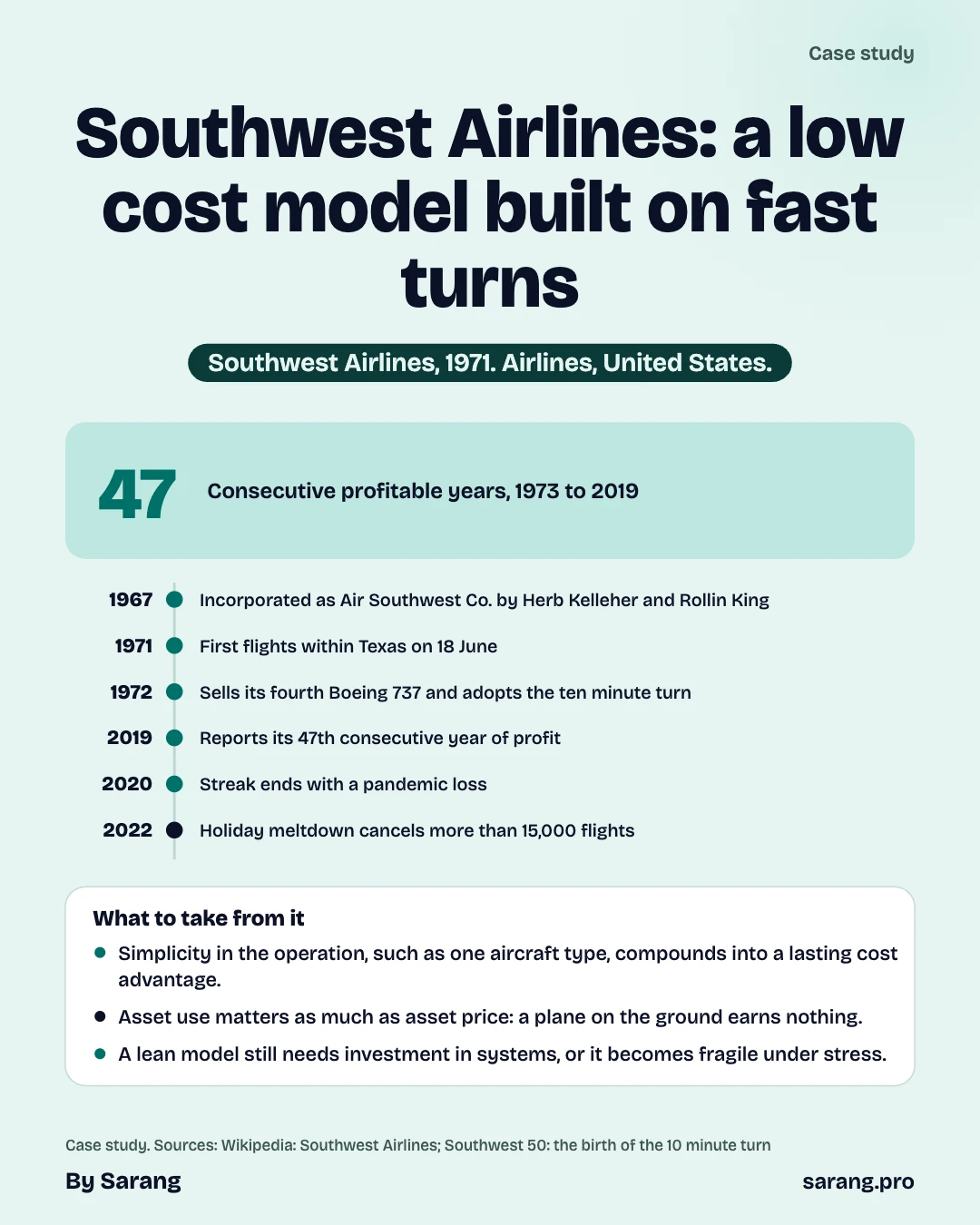
Southwest Airlines turned a 1972 cash crisis into a ten-minute gate turn and 47 profitable years, then dropped open seating and free bags after 2022 and investor pressure.
- Southwest loss in 1972
- $1.6 million
- target time to turn an aircraft at the gate
- 10 minutes
- consecutive profitable years as of January 2020
- 47 years
- Boeing 737s in the fleet at the end of 2025
- 803
The situation
In spring 1972 Southwest Airlines had about $143 in the bank, by one account, and a loss for the year of $1.6 million. It was a young Texas carrier with a handful of Boeing 737s, serving three cities, and it had spent years in court just for the right to fly. Its president, Lamar Muse, planned to sell one of the four aircraft, bought in September 1971, for roughly $500,000 to keep the company alive.
Selling a plane created a problem. The three that were left had to fly the same timetable as four. The answer was to turn each aircraft around at the gate in about ten minutes, far faster than competitors did. Bill Franklin, the executive in charge of terminal operations, was given the job. Southwest made its first profit within a year and, by one count in 2020, was profitable for 47 years in a row.
This case follows how a cash crisis produced an operating model: one aircraft type, short flights between cities, quick turns at the gate, low fares and a flexible workforce. It then looks at how that model was tested by the 2022 holiday collapse, by investor pressure, and by the decision in 2024 to end open seating and, in 2025, to start charging for checked bags. The question is how much of a low cost model is an identity and how much is simply a set of choices that can be changed.
Background
A licence won in court
Rollin King and Herb Kelleher conceived Southwest as a low-fare, no-frills carrier that would fly within Texas between Houston, San Antonio and Dallas. The company was incorporated as Air Southwest on 15 March 1967. When it applied to the Texas Aeronautics Commission in 1968, the commission granted the licence unanimously over the objections of Braniff and Trans-Texas (later Texas International). The incumbents then took the case to the courts. Southwest won at the Texas Supreme Court in May 1970, and the US Supreme Court declined to hear the case, with Texas State Historical Association dating the final ruling to 7 December 1970.
The fight was not over. Opponents took it to the Civil Aeronautics Board, arguing that Southwest was in fact in interstate commerce, and the appeals did not end until December 1972. A Texas Monthly account from 1975 reports that Southwest had spent about $2 million on legal costs since 1968, around $35 per flight at the time.
Launch and early survival
Muse became president in January 1971, when the company had $148 in the bank. Southwest started with three Boeing 737-200s and flew its first service from Dallas Love Field on 18 June 1971. According to the Texas Monthly piece, competitors allegedly cut fares on the same day to match. Its early fares were two-tier, including $10 fares on the last flight of the day, and in 1972 it fought a fare war with Braniff by offering a choice between a $13 fare or a full fare that came with a bottle of liquor.
Money still ran short. KERA reports a net loss of $1.6 million by 1972. That is the context for the plane sale and the ten-minute turn.
Where Dallas airports came in
Dallas and Fort Worth built a new regional airport, Dallas/Fort Worth, and required carriers to move there. Southwest stayed at Love Field and at Houston Hobby. The Texas Monthly article says it kept using both. Later, the Wright Amendment of 1979 restricted flights out of Love Field to Texas and neighbouring states; the TSHA entry says Congress repealed it in October 2014.
The industry
The industry that Southwest entered in 1971 was a regulated one. Incumbents such as Braniff and Texas International fought the new carrier through the courts and the Civil Aeronautics Board for years. The Airline Deregulation Act of 1978 opened routes across the country, and Southwest expanded beyond Texas in 1982 according to TSHA. By 1989 it was a “major” carrier, with annual revenue above $1 billion.
A short-haul, point-to-point carrier faces a particular arithmetic. An aircraft earns money only when it is in the air, and a short route means many more take-offs and landings per day than a long one. Each minute on the ground between flights is therefore expensive. This is the economic logic behind the ten-minute turn. Southwest’s 2025 annual report still describes the strategy in these terms: a low-cost strategy built on its route structure, including service to secondary and downtown airports that help it keep aircraft on the ground for less time, and primarily point-to-point service, with direct routes rather than hubs.
Regulation shaped what was possible. Boarding first-come, first-served and pushing back before every passenger had settled was practised in the 1970s and was ended by the FAA in 1986, according to Southwest’s own history site. Later regulation, more complex operations and tighter security made the exact ten-minute pace impossible, though Southwest kept some of the quickest turns in the industry.
The decision
What was at stake in 1972
With only a few aircraft and losses running, the airline had three broad ways to go. Each was a way of dealing with the same fact: the cost of an idle aircraft.
Option one: shrink the timetable
Selling the fourth aircraft meant three planes could not fly a four-plane schedule at normal turn times. The obvious choice was to cut flights, which would also have cut revenue and made the airline less useful to the business travellers it relied on. This is a framing of the alternative, not a record of what the board debated.
Option two: raise fares or take on debt
The company was already in a fare war with Braniff. Lamar Muse claimed in 1975 that Braniff had lost about $4 million in the 1973 war, roughly half its domestic profit that year, though Braniff disputed the number. Raising fares in that fight was not realistic, and the airline had little credit to borrow against.
Option three: change how the aircraft is used
Franklin’s proposal was to make the same planes work harder by shortening the time at the gate. The sources describe how: crews collected trash, refuelled and unloaded bags while passengers were still leaving. New passengers lined up as others stepped off. Teams studied race-car pit crews and reviewed every step, which involved more than 100 tasks, and everyone joined in, including pilots and Herb Kelleher. KERA records a threat from Franklin to replace staff who could not meet the target, and a flight attendant remembered that the staff went along with it.
The sources disagree about when profit came. KERA and the Texas State Historical Association say the first profit was in 1973; Southwest’s own anniversary site says the ten-minute turn and a $13 fare programme returned the airline to profitability in 1972. The balance of the evidence points to 1973.
What they did
The ten-minute turn
The ten-minute turn did not always succeed, but it was fast enough to become the airline’s signature. It required people to do several things at once and to accept that gate work was a shared job. A pilot or an executive could pick up a bag. The practice also set a standard for how the airline measured its own work: time on the ground. Southwest later tested handheld baggage scanners, mobile gate readers, real-time communication between crew members and dual-door boarding at San Diego and Sacramento in 2019, which shows that the aim of faster turns lasted for almost half a century.
One aircraft type
The airline standardised on the Boeing 737, a decision the TSHA entry links to pilot training and maintenance. The fleet in 2025 was 803 Boeing 737s, per the annual report. Using one type means any pilot can fly any aircraft, any mechanic can fix any plane, and the stock of spare parts is smaller. The cost is dependence on a single manufacturer. An airline with one family of aircraft has no other type to fall back on if that family has a problem.
Low fares on short flights
Southwest priced low, offering simple fares and a single class of seat. Fares such as $13 and $10 were used in the 1970s to fill seats. The Valley market illustrates the pattern: the Texas Monthly article reports Southwest charging about $25 against Texas International’s $40, and carrying 785 passengers a day from Harlingen in August 1975, against 305 for Texas International in 1973 and 331 in 1974.
Trade-offs of the model
The same features that cut cost also removed slack. A schedule built around quick turns, a single aircraft type and direct routes works when each part runs to time, and each part depends on the others. The fast turn needs staff who will cross job boundaries. The single fleet needs a supplier that delivers. Short point-to-point flying means that when something goes wrong, it spreads across a network with no hubs to recover through. None of this made the model a bad one. It meant that its strengths and its weak points came from the same design.
Listing, growth and the people
Southwest listed on the New York Stock Exchange as LUV in 1977. Kelleher became permanent chief executive in 1982 and stepped down in 2001. By the early 1990s it was the seventh-largest US airline, with more than 35 million customers a year, more than $2 billion in revenue and over 15,000 staff. In 2000 it reported about $5.6 billion in sales and $603 million in net income. After the attacks of 11 September 2001, TSHA says, it was the only major airline to protect employee jobs.
What happened
A long run of profit
TSHA says Southwest posted profits for 47 years as of January 2020. In 2020 it reported a record loss of $3.5 billion before special items, its first in 48 years, as traffic fell 97 per cent in the pandemic; it returned to profit in the fourth quarter of 2021 without federal support. TSHA’s two figures for the streak are not perfectly consistent with each other, so the length should be read as roughly 47 to 48 years.
| Measure | Figure | Source |
|---|---|---|
| Loss, 1972 | $1.6 million | KERA |
| Revenue passes $1 billion | 1989 | TSHA |
| Sales, 2000 | About $5.6 billion | TSHA |
| Loss, 2020 (before special items) | $3.5 billion | TSHA |
| Fleet, end 2025 | 803 Boeing 737s | 2025 annual report |
The 2022 holiday collapse
Over the 2022 year-end holiday period the airline cancelled nearly 17,000 flights and stranded about two million people, according to a CNBC report from 18 December 2023. The US Department of Transportation found that the call centre was overwhelmed, with busy signals and full queues, that help and flight-change notices were insufficient, and that refunds and reimbursements were slow. It imposed a $140 million penalty, which it said was 30 times larger than any previous consumer protection fine it had issued. Of that, $35 million was payable in cash over three years and $33 million was credited for frequent flyer miles given to affected passengers. The disruption cost the airline more than $1 billion, including more than $600 million in reimbursements and refunds. Chief executive Bob Jordan said it would never happen again.
The point-to-point model, with no central hubs, means a crew or aircraft that ends up in the wrong city stays out of position and has to be repositioned. This account does not claim that structure was the cause: the sources listed describe the symptoms, not the technical diagnosis.
The 2024 and 2025 changes
On 26 September 2024, at its investor day, Southwest announced that it would end open seating and offer premium legroom seats for the first time, having first signalled the move in July. It said 80 per cent of its customers, and 86 per cent of passengers who chose other airlines, wanted assigned seats. The activist investor Elliott Investment Management was pressing for management and profit changes, though Southwest said its seating plans predated that pressure. In February 2025 it cut about 1,750 roles, about 15 per cent of corporate positions. For bookings made or changed from 28 May 2025 it began charging bag fees on most fares. The last open-seating flight left Honolulu on 26 January 2026, and assigned seating began the next day, with boarding in eight groups.
Other views
Employees and the “worker-first” claim
The model has relied on staff who accept flexible roles, and the airline’s reputation for treating its people well is part of its story: TSHA records that it protected jobs after the attacks of 2001. Cuts in 2025 therefore test that reputation. The filing says the company implemented a reduction in workforce and plans to continue efforts to right-size staffing. The sources opened here do not carry employee reactions, so the effect on morale is left open.
Customers and the case for assigned seats
Southwest’s surveys in 2024 found that most travellers wanted to know their seat before the airport, and that open seating was the top reason surveyed travellers gave for choosing another airline. That reads as evidence that a feature once seen as part of the brand had become a cost. The airline also points to the fact that almost every other airline offers reserved seating. The counter view is that a distinctive offer, once abandoned, leaves Southwest looking more like its rivals. The sources do not say how customers have reacted since January 2026.
Regulators
The 2023 fine shows how regulators now treat a failure to look after passengers in disruption. The Transportation Secretary, Pete Buttigieg, said the department would use the full extent of its authority to hold airlines accountable. The order also required a compensation fund for future disruptions within the airline’s control.
Limits of the evidence
Most early detail comes from oral accounts and the company’s own anniversary material, and details such as the cash balance ($148 in January 1971, $143 in spring 1972) differ between sources. The accounts of fare wars come from a 1975 magazine piece reporting claims made in litigation.
Reading it through a framework
Porter’s generic strategies
Michael Porter’s cost leadership strategy depends on a cost advantage that is hard to match and on a coherent set of activities. Southwest’s activities fit each other: a single 737 type, secondary airports, point-to-point routes, fast turns, a single class of seat and simple fares. The reason the pieces count as a strategy is that they reinforce one another. A fast turn is easier with a single type and with a boarding method that is quick. Yet Porter also warned about being stuck in the middle. The move towards premium seats, bag fees and a revenue push can be read as a step away from pure cost leadership, with the risk of ending up with neither the lowest cost nor a clear premium offer.
Value chain and fit
Looked at through a value chain, the ten-minute turn is an operations activity that creates the airline’s main advantage: more flights per aircraft per day. Open seating and free bags were service choices that sat alongside the speed strategy, and changing them alters the fit between activities. The 2022 collapse showed that support activities, including crew scheduling and customer contact, can limit the whole chain even when operations are strong.
Since then
By the end of 2025 Southwest operated 803 Boeing 737s to 117 destinations in 42 states, the District of Columbia, Puerto Rico and ten near-international countries, with 72,790 full-time equivalent employees. Its annual report still describes a low-cost strategy and primarily point-to-point service. The company introduced assigned and extra-legroom seating from 27 January 2026, with standard, preferred and extra-legroom options, and two free checked bags remain for A-List Preferred members and Choice Extra fares, with one for A-List members and co-brand cardholders. Chief executive Bob Jordan said the aim was to return to the levels of profitability the company and its shareholders expect.
What to take from it
- A constraint can produce a distinct way of operating: the ten-minute turn grew out of a plan to sell an aircraft and keep the schedule.
- Standardising on one aircraft type lowers training, maintenance and spare-parts costs but ties the airline to one manufacturer.
- Activities in a cost strategy work as a set, so changing a popular feature such as open seating or free bags has effects beyond the revenue it brings.
- Lean operations have little slack for disruption, and the 2022 collapse and its $140 million fine show how a recovery failure can outweigh years of efficiency.
- A founder-era identity can become a constraint when customers and investors want something different, and a company has to decide which parts are essential.
Questions to think about
- Which of Southwest’s original choices were essential to low cost, and which were habits that happened to be popular?
- Is a record of 47 years of profit evidence that the model was sound, or that conditions were favourable?
- If you ran a short-haul airline today, which features would you keep free, and how would you test the effect of charging?
- How should a company weigh pressure from an activist investor against a brand built over fifty years?
Concepts at work
Cost leadership, operational fit between activities, and capacity utilisation. Explore them in Insights.
Written from the public sources listed below. Figures are as those sources report them.
Framework
Timeline
- 15 Mar 1967Air Southwest incorporated
- 7 Dec 1970US Supreme Court lets Southwest's Texas licence stand
- 18 Jun 1971First flight from Dallas Love Field
- 1972Loss of $1.6 million and the ten-minute turn
- 1973First profit reported
- 1977Shares listed on the New York Stock Exchange
- 1979Wright Amendment limits flying from Love Field
- 1989Revenue passes $1 billion
- 2020Record loss as pandemic cuts traffic
- Dec 2022Holiday cancellations strand about two million people
- Dec 2023$140 million penalty announced
- 26 Sep 2024End of open seating announced at investor day
- 28 May 2025Bag fees begin on most fares
- 27 Jan 2026Assigned seating begins
Recap cards
Tap a card to check yourself.
Sources and credits
- KERA News: The man who saved Southwest Airlines with a 10-minute idea
- Southwest Airlines: A turning point, the birth of the 10-minute turn
- Texas State Historical Association: Southwest Airlines
- Texas Monthly: The Great Airline War
- CNBC (via NBC DFW): Southwest fined $140 million for last year's holiday meltdown
- ABC13: Southwest reveals when and how it will get rid of open seating
- Fox 13: Southwest ends open seating era with final flight
- Southwest Airlines: Form 10-K for 2025