Tropicana: a new carton that shoppers rejected within weeks
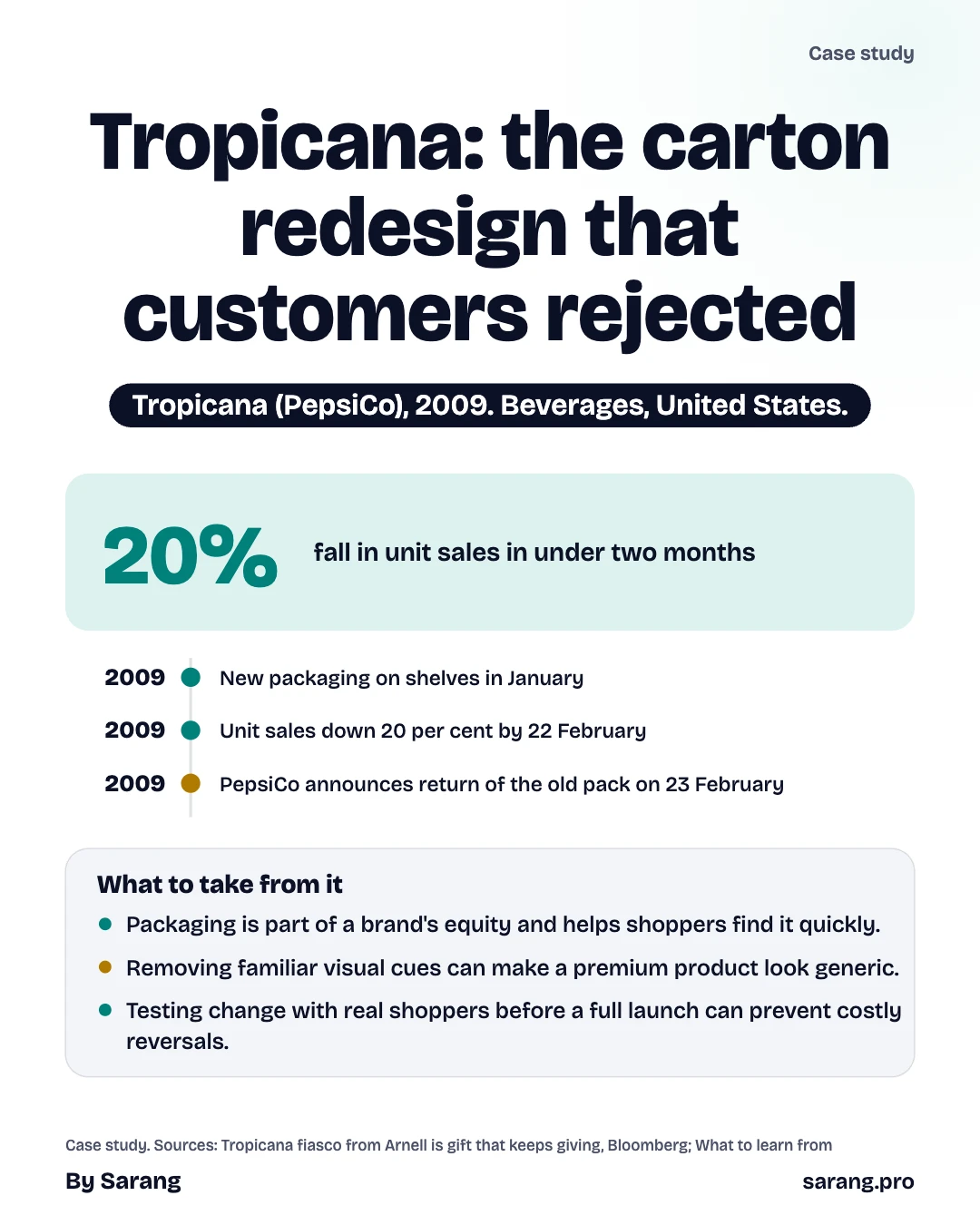
Tropicana replaced the orange-and-straw carton on its Pure Premium juice in January 2009, saw unit sales fall 20 per cent by 22 February, and went back to the old design.
- Fall in unit sales, 1 Jan to 22 Feb 2009
- 20%
- Advertising behind the new pack
- $35m
- Date the return to the old pack was announced
- 23 Feb 2009
- Reported total cost of the episode (sources differ)
- $50m+
The situation
In January 2009 Tropicana, the orange juice brand owned by PepsiCo, put a new carton on North American shelves for its best-known product, Pure Premium. The old carton had carried a picture of an orange with a straw stuck in it. The new one showed a tall glass of juice, moved the orange to a squeeze-shaped cap, turned the logo to run vertically and replaced the “Pure Premium” wording with “100% Orange Pure and Natural”. It came with a $35 million advertising campaign built on the line “Squeeze, it’s a natural”.
The juice inside had not changed. Only the packaging had. Within weeks, customers were writing in, online and to the company, to say they disliked it. Fortune later reported that unit sales fell 20 per cent and dollar sales 19 per cent between 1 January and 22 February 2009, while two rivals, Florida’s Natural and Minute Maid, posted double-digit gains in unit sales over the same period. On 23 February 2009 the company announced it would go back to the old carton.
The reversal took about six weeks from launch, according to one account. Sources disagree on the total cost, and on how large the brand was before the change, so this case gives ranges where they differ. What they agree on is the shape of the event: a market leader changed the look of a product people bought from habit, sales dropped quickly, and the company retreated. The case is useful because the product itself was left alone, which isolates the effect of the package.
This case sets out the background of the brand, the market it sold in, the choices open to Tropicana, what it did, the evidence on results and the criticism it drew. It then applies two frameworks and follows the brand to 2024, when another redesign provoked a similar reaction.
Background
From Bradenton to PepsiCo
According to Logo Heritage, Anthony T. Rossi founded Tropicana in 1947 in Bradenton, Florida. PepsiCo bought the business in 1998 for $3.3 billion, which BeverageDaily describes as its largest acquisition at the time. That site also records that PepsiCo bought Naked Juice in 2006 for $150 million. Tropicana therefore sat inside a very large food and drinks group, as a division, when the 2009 redesign happened.
The product and its look
Pure Premium was Tropicana’s top-selling product. For years the carton had shown an orange pierced by a straw. Logo Heritage lists a long run of changes to the Tropicana wordmark between 1947 and the present, including the green wordmark with a ribbon in the late 1990s and a curved wordmark with a gold-veined leaf from 2007. These were changes to the logo over decades. The 2009 package was a bigger break, because it replaced the central picture that shoppers recognised from a distance.
How much the brand was worth
Sources differ on the size of the line. The Branding Journal says annual sales of the product before the redesign were more than $700 million. Another account, from Intuitive Stories, gives Tropicana’s annual orange juice sales as over $300 million. The two figures cannot both be right as stated, and neither is taken from a company filing. They may describe different things, such as the whole brand against one product, but the sources do not say. Either way, the brand was large enough that a 20 per cent fall meant tens of millions of dollars.
The agency and the brief
The new design came from the agency run by Peter Arnell. The Branding Journal calls the campaign slogan “Squeeze, it’s a natural”, and says Tropicana spent $35 million on advertising to support the new packaging. Tropicana’s North America president, Neil Campbell, was quoted in the New York Times, as reported by a design blog, saying the company had underestimated the deep emotional bond between consumers and the original packaging.
The industry
A category built on shelf habit
Orange juice in a carton is a repeat purchase. Shoppers tend to pick up the same product weekly, often without reading the label. In that setting the pack acts as the main way a buyer finds the brand in the chilled aisle. The orange-and-straw picture did this job, and the evidence from complaints is that people used it as a signal. A design blog quoting the New York Times says critics called the new carton a generic or store brand, and a reader comment on another blog said it was harder to find on the shelf.
Rivals ready to take the sales
The Fortune report names Florida’s Natural and Minute Maid as the competitors that gained during the weeks of the redesign. The Branding Journal says rivals gained what Tropicana lost. A buyer who walked past the unfamiliar carton would have found a branded rival close by, with no need to think about the choice. In a market with close substitutes, a buyer who cannot find a familiar pack can switch with little effort, and the sources suggest that is what happened.
Long-run trends in juice
The sources opened do not give market-share figures for 2009. They do give a later view of the category. When PepsiCo sold most of Tropicana in 2021, BevNET quoted Howard Telford of Euromonitor saying that the long-term trend for fruit juice was still downward despite recent gains. PepsiCo said its juice businesses had lower operating margins than the company as a whole. So the category was one in which a leading brand had little room for a costly mistake.
What was known about packaging risk
The Branding Journal cites a 2009 article in Brand Packaging by Scott Young and Vicenzo Ciummo arguing that packaging redesigns normally cause only small, short-lived dips in sales, never as severe as 20 per cent. If that is right, the Tropicana outcome was unusual, and the redesign should be judged as an outlier and not as a typical case of packaging change. The original article was not opened for this case, so the claim is reported as the Branding Journal states it.
The decision
The sources do not set out the internal options in detail. The alternatives below are the obvious ones, framed as alternatives and not as a record of meetings.
Option one: leave the carton alone
The orange-and-straw pack was recognised and the product was selling. This option would have kept the brand’s strongest visual cue in place and left the $35 million unspent. Leaving it unchanged carried no risk of the kind that followed. The reason to change, as far as the sources show, was a wish to refresh the look and push a message about natural juice, which the new wording “100% Orange Pure and Natural” and the campaign line both reflect.
Option two: a gradual change
The company could have changed the carton in steps, keeping the orange picture while altering other parts, or tested the new design in a few regions first. The sources do not say whether a test was run. The Branding Journal’s point that redesigns usually cause small dips suggests that most firms treat packaging as low risk, which may be why a full national launch seemed safe.
Option three: a full redesign with a large campaign
This is what Tropicana chose. It changed the image, the logo layout, the cap and the wording at once, and backed the change with a $35 million campaign. Changing everything together made the pack look new, and it also removed every cue a loyal buyer relied on. A decision like this bets on the new look being at least as easy to recognise as the old one. The results show the bet was lost.
What was at stake
The stake was a large and steady revenue line. A change that worked could have lifted the brand’s image. A change that failed risked handing sales to competitors who might keep the customers they won. Pepsi’s marketing chief, David Burwick, is reported to have said, “Sometimes you land in a great place, and sometimes you don’t.” The cost of being wrong included both the lost sales and the cost of reversing course.
What they did
The launch, January 2009
The new packaging for Pure Premium appeared in January 2009. The Branding Journal gives 8 January in one place and 9 January in another, and Logo Heritage gives 9 January, so the exact date differs by a day across sources. The glass of orange juice replaced the orange with a straw, the logo turned vertical and smaller, and the squeeze-shaped cap carried the orange. The $35 million campaign ran alongside.
The reaction
Criticism appeared in the first weeks, especially on social networks according to the Branding Journal. A design blog quoting the New York Times says critics called the packaging ugly and said it looked like a generic or bargain brand. Fortune’s later article records one customer asking whether the designers had ever shopped for orange juice. Intuitive Stories reports that loyal customers complained within weeks that they missed the original orange-and-straw picture.
Peter Arnell’s defence
Arnell defended the work. Fortune quotes him explaining the cap with the words, “‘Squeeze’ maintains a certain level of, I guess, power”. Intuitive Stories reports him saying the change was hard for people to take in because “it’s so dramatic”. These remarks show a designer arguing that the idea was right and the public had not caught up. The sales data did not support him.
The reversal, 23 February 2009
On 23 February 2009 Tropicana announced that it would restore the original packaging. The Branding Journal and Logo Heritage both give that date, and the old cartons returned to shelves within a few months. Logo Heritage puts the reversal about six weeks after launch. The company’s North America president said it had underestimated the emotional bond with the old design.
What happened
Sales and costs
| Measure | Figure | Source |
|---|---|---|
| Unit sales, 1 Jan to 22 Feb 2009 | Down 20 per cent | Fortune |
| Dollar sales, same period | Down 19 per cent | Fortune |
| Advertising for new pack | $35 million | Branding Journal, Fortune, Intuitive Stories |
| Annual sales before redesign | Over $700 million, or over $300 million | Branding Journal; Intuitive Stories |
| Estimated sales loss | About $30 million | Branding Journal |
| Total cost of the episode | More than $50 million | Branding Journal; Logo Heritage |
The sources agree on the headline fall of about 20 per cent in two months. They differ on the money. The Branding Journal puts the loss near $30 million and the full cost above $50 million, which would include the advertising. Both are secondary estimates and none comes from a company statement.
What rivals did
Competitors gained in the same weeks. Fortune’s report that Florida’s Natural and Minute Maid posted double-digit unit gains shows that shoppers who left Tropicana went to other branded juices, not away from the category. The sources opened do not say how many of those buyers came back after the old carton returned.
How quickly it unfolded
The timing is part of the evidence. Fortune’s sales window runs from 1 January to 22 February, which means the measured fall covers the first weeks after launch and the reversal came the day after the window closed. A drop that large in so short a time points to a direct reaction to what shoppers saw on the shelf, since slower influences such as a change in household budgets or in taste tend to work over months. The sources do not report how fast sales came back once the old carton returned, so the recovery side of the story cannot be told from them.
The new logo era
Logo Heritage records a wordmark in white on a green banner from 2010 onward, and a warmer orange palette from 2017. The 2009 redesign was dropped, but the brand’s identity kept changing in smaller steps afterwards.
Other views
Was it only the packaging?
Some commenters argued that the sales fall had several causes. Intuitive Stories reports a reader saying that economic conditions and competition also played a part. Weak economic conditions could have pushed shoppers towards cheaper products, though the sources do not measure that. They do not separate the effects, and the speed of the drop and the speed of the recovery after the reversal are the strongest evidence for the packaging.
Designers and the public
Arnell’s defence, that the design was strong and people needed time, is one view in the design trade. The counter-view is that a pack has to work in a few seconds on a crowded shelf, and a design that people cannot find or mistake for a store brand has failed whatever its artistic merit. The company’s own retreat, within about six weeks, shows which side it took.
The research gap
A blog account says that changing a visual identity without customer research can hurt a brand even when the product does not change. That is a general lesson and not a finding from the sources about what Tropicana did or did not test. The sources opened do not describe the research behind the redesign, so no claim is made either way. What can be said is that the speed of the reaction, within weeks of launch, suggests that a test with real shoppers in real stores, even a small one, would have shown the problem before the national launch and the full advertising spend.
Limits of the evidence
Much of what is online about this case repeats the same few facts and some figures differ by source. Dates differ by a day, brand sales differ by more than double, and several blogs give numbers with no reference. This case therefore relies mostly on Fortune, the Branding Journal and the PepsiCo sale coverage, and marks other figures as uncertain.
Reading it through a framework
Switching costs
Switching costs are what a customer gives up or must do to change supplier. For juice in a carton, money costs are near zero, since a rival is a few feet along the same shelf. The costs that remain are habit and recognition. The orange-and-straw pack lowered a buyer’s effort to a glance. By removing it, Tropicana raised the effort of staying loyal. Once the effort of finding the product came close to the effort of trying a rival, the habit that protected the brand weakened. The fast rise of Florida’s Natural and Minute Maid fits this reading.
Brand equity
Brand equity is the value a name and its signs add to a product beyond the product itself. Here, the juice was identical, yet buyers acted as if the product had changed. That tells us that part of Tropicana’s value sat in the picture on the carton. Campbell’s remark about an emotional bond points the same way. A redesign that treats the visible signs as free to alter risks spending equity that took years to build, and the cost of rebuying it, here over $50 million on one estimate, can be large.
Since then
PepsiCo kept Tropicana until 2021. On 3 August 2021, according to BeverageDaily, it announced a deal to sell a controlling stake in Tropicana, Naked and other juice brands to the private equity firm PAI Partners for about $3.3 billion, keeping a 39 per cent stake in a joint venture. The juice businesses together had around $3 billion in net revenue in 2020, the same report says. PepsiCo kept US distribution rights through its chilled delivery system and said it would use the proceeds mainly to strengthen its balance sheet and fund organic investment. The new owner is the Tropicana Brands Group.
In summer 2024 the brand again changed its bottle. Fortune reported that bottles shrank from 52 to 46 ounces, with a shelf price of $3.99, about 70 cents below the old design’s price. Customers criticised it as shrinkflation, since at Walmart the new bottle cost 7.7 cents an ounce against 7.6 cents for the old one. Circana data cited by CNN and relayed by Fortune showed sales falling 10.9 per cent in August and 19 per cent by October. Tropicana Brands Group said third-party data showed sales returning to normal and that the new bottle was easier to pour and store and used less plastic in the cap. The company is now privately held, so its sales data is not public, and the claims on each side cannot be checked.
The 2024 episode differs from 2009 in that it involved size and price as well as look, so the sources do not support treating it as a repeat. It does show a pattern: customers of a long-established food brand notice and react to changes in its familiar form.
What to take from it
- A pack is part of the product for habitual buyers, so changing it can change sales even when the contents are identical.
- Changing every visible cue at once removes the signals loyal customers use to find a brand, and it is safer to change in steps or test first.
- In a market with close substitutes, rivals gain quickly from a leader’s mistake, so a quick reversal can limit the damage.
- Estimates of cost and sales from secondary sources differ widely, and a careful analyst states the range instead of picking one number.
- Admitting an error quickly, as Tropicana did within about six weeks, can cost less than defending the choice.
Questions to think about
- What evidence would you have wanted before approving a national launch of the new carton? How long would you have tested it?
- If a rival brand had gained customers during the six weeks, what could Tropicana have done to win them back?
- Is a designer’s view of a good pack ever more reliable than customers’ reactions? When?
- How should a brand tell the difference between a pack that needs a refresh and one that carries equity worth protecting?
Concepts at work
This case draws on brand equity, switching costs and change management in consumer goods. Explore them in Insights.
Written from the public sources listed below. Figures are as those sources report them.
Framework
Timeline
- 1947Tropicana founded in Bradenton, Florida
- 1998PepsiCo buys Tropicana for $3.3 billion
- Jan 2009New Pure Premium carton launched
- 23 Feb 2009Return to the original carton announced
- 2010Wordmark moves to white on a green banner (per Logo Heritage)
- 3 Aug 2021PepsiCo announces sale of controlling stake to PAI Partners
- Summer 2024Bottle cut from 52 to 46 ounces
- Oct 2024Circana data reported sales down 19 per cent
Recap cards
Tap a card to check yourself.
Sources and credits
- The Branding Journal: What to Learn From Tropicana's Packaging Redesign Failure?
- Fortune: Tropicana bottle packaging redesign backlash and shrinkflation
- Intuitive Stories: Tropicana and the importance of consistent package design
- Logoworks: Tropicana, the case of an unsuccessful rebranding attempt
- BeverageDaily: PepsiCo to sell Tropicana, Naked and other juice brands to private equity firm
- BevNET: PepsiCo Sells Tropicana, Naked Juice Brands to Private Equity Firm
- Logo Heritage: Tropicana logo history