Zara: how a supply chain kept close to home made fast fashion fast
Zara kept much of its production near Spain and committed only about 15% of stock in advance, which helped Inditex reach €38.63 billion of sales in the year to January 2025.
- design to store, as reported by HBR in 2004
- 15 days
- share of production from proximity suppliers, 2015
- 51%
- share of production planned in advance, 2015 (about 60% at a typical retailer)
- 15%
- Inditex sales, year to 31 January 2025
- €38.63 billion
The situation
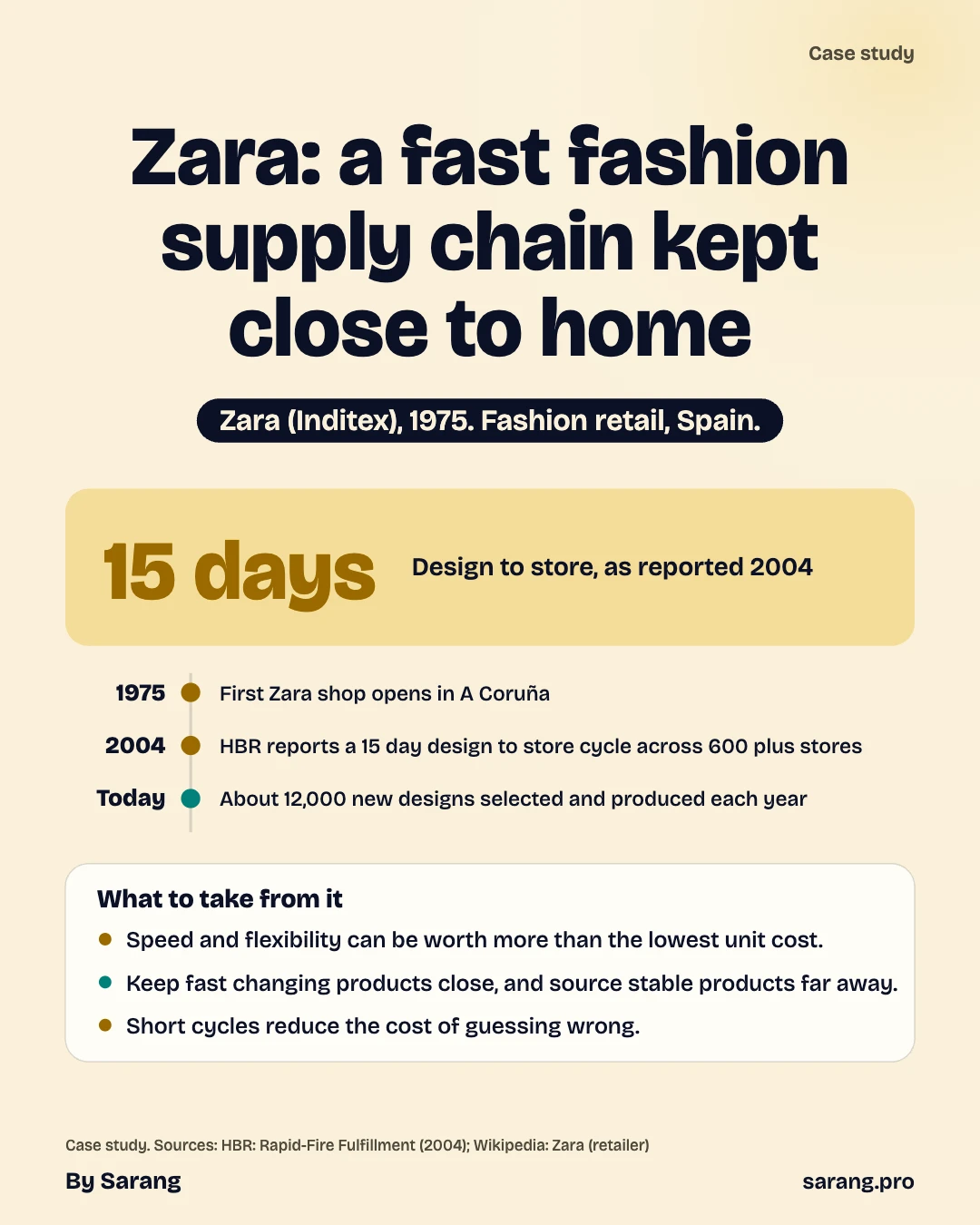
For most of the 1990s and 2000s, the standard advice to a clothing retailer was to move production to wherever labour was cheapest and to order early, in large volumes, to win the best unit price. Zara did something close to the opposite. It kept a large share of its production near its Spanish base, made garments in small batches and paid for spare factory capacity so that it could react quickly. A 2004 article in Harvard Business Review reported that Zara could design, produce and deliver a new garment to its 600-plus stores worldwide in 15 days.
The choice is hard to pin to a single date. The sources show a pattern that built up from the opening of the first shop in 1975 and was still visible forty years later. A 2015 Business of Fashion profile found that at least 51% of the production base of Inditex, the group that owns Zara, was “proximity sourced” from suppliers near its Spanish distribution centres, in countries such as Spain, Portugal and Morocco. It reported that a conventional high street retailer commits about 60% of its production before the season starts, while Inditex commits about 15% and makes the rest in response to what customers buy.
This case asks why a company would accept higher labour costs and idle capacity, and what it gained in return. The short answer in the sources is speed, and with speed came less unsold stock, fewer markdowns and a reason for shoppers to visit often. The longer answer is more mixed, because the model has costs, and the sources show some of them.
Background
A shirt maker’s son in Galicia
Amancio Ortega grew up in Galicia, a rainy and then economically poor region in north-west Spain. NPR reported in 2013 that he was the son of a railway worker and started work at 14 in a local shirt shop called Gala. He opened the first Zara store in 1975, two blocks from Gala. The HBR article gives a more specific origin: a German wholesaler cancelled a large order of lingerie, and Ortega opened a shop near his factory in La Coruña to sell the goods himself. The two accounts agree that the shop began as an outlet for a business that already made clothes.
This origin matters because it set the pattern of a retailer that owned its manufacturing. NPR noted that Gala still sews shirts upstairs from its shop floor, a link between making and selling that Ortega carried into Zara. In 2013 Forbes ranked Ortega third on its list of billionaires, with a net worth NPR put above $56 billion.
From one shop to a global group
By 2004 the HBR article counted more than 600 Zara stores and steady annual growth of 20%, during what it called a difficult economic period. Inditex listed on the Madrid stock exchange in 2001, and Business of Fashion put its market value at about €9 billion at the time of the flotation. By the time of its 2015 profile the market value was €87.5 billion. By 2013 NPR counted about 6,000 stores in 85 countries across Zara and seven other brands, and Inditex planned about 500 openings that year. Business of Fashion counted more than 6,500 stores in 88 markets in 2015, with 70% in Europe, 9% in the Americas and 21% in the rest of the world.
These counts are for the whole group in 2013 and 2015 and for Zara alone in 2004, so they are not a like-for-like series. Even so, the direction is clear: the group multiplied several times over in a decade while keeping its supply approach.
How the money was made
Zara earned money by selling at close to full price and by selling less at a discount than rivals did. The HBR article said it stocked small quantities of each item, which made shoppers feel they should buy at once, and cleared unsold goods from stores after about two weeks. NPR reported that Zara spent almost nothing on advertising. It put money into large shops in prominent places instead, including a store on New York’s Fifth Avenue that NPR said cost $324 million. A fashion expert quoted by NPR, Jose Luis Nueno, summed up the logic: “If I change the merchandise very frequently, then I give you an excuse to come to the store more frequently.”
The industry
Clothing retail in the 2000s was organised around seasons. Buyers chose designs months ahead, ordered large quantities from factories that were often in Asia, and shipped them by sea. Business of Fashion’s 2015 figure of 60% pre-committed stock for a typical retailer shows how much of the risk was settled before anyone knew what would sell. NPR described the old standard as about six months from design to shop.
Zara worked to a different rhythm. NPR called its parent a fast fashion empire, and the HBR article and the Business of Fashion profile both show new items reaching stores within weeks and leaving within a fortnight or so if they did not sell. Louis Vuitton’s fashion director saw it as a rival to watch (see Other views).
The economics follow from the order cycle. A retailer that commits early gets cheaper units but carries the risk of misjudging taste, and it pays for that risk later in markdowns. A retailer that commits late pays more per unit but can match supply to demand. Zara’s bet was that the second kind of cost was smaller than the first. The HBR article described Zara’s practices as unconventional, including shipping trucks that were partly loaded across Europe, airfreighting coats to Japan twice a week and running factories on a single day shift.
Regulation and ethics also shaped the industry. Clothing supply chains pass through many sub-contractors, and the sources show that Zara’s outsourced suppliers in Brazil were found to be using illegal workshops (covered under Other views). A buyer’s physical closeness does not guarantee clean supply chains, and Indalecio Pérez of Inditex’s corporate social responsibility department told Business of Fashion in 2015 that the CSR systems and the buying systems were totally integrated.
The decision
What was at stake
The decision was about where to put capital and control. Spending on factories, spare capacity and logistics in Europe would raise costs per garment. The gain would be a faster reaction to the market, which reduces the chance of leftover stock. If sales held up, the extra cost per unit would be repaid in fewer markdowns. If the strategy failed, Zara would carry the cost of high labour rates and idle plants with no matching benefit.
Option one: move production to low-cost countries
This was what many competitors did, and the sources describe it as the usual route. NPR said Zara kept production close to home, mainly in Spain and Portugal, “while many competitors moved factories to Asia”. The lower unit cost is real, but the order has to be placed early, and the shipping time is long. A retailer on this path commits the larger share of its stock in advance.
Option two: keep design, cutting and logistics under one roof
The HBR article reported that Zara kept nearly half of its output in-house and handled design, warehousing, distribution and logistics itself, which it contrasted with the outsourcing common among rivals. NPR also said every garment passes through Spain and that more than half of the production is local. NPR described this as owning the supply chain from factory to shop.
Option three: a mix
The Business of Fashion profile shows a middle course in practice. Inditex owned only a “small single digit” percentage of its manufacturing, which means that by 2015 most of the work was done by outside suppliers. But a large share of those suppliers were close to the Spanish distribution centres. The proximity model therefore did not require owning factories. It required suppliers within reach and close relationships with them. The profile gave an example: a Moroccan denim supplier group with five factories and about 2,000 staff, for which Inditex made up around 80% of orders. That dependence gives the buyer power over the supplier, and it shows what the supplier is trading away for steady volume.
The sources do not say how the company weighed these options at a particular board meeting, and this case does not claim to. The options are laid out here as the obvious alternatives, with the evidence of which one the company followed.
What they did
Keep control of design and the flow of goods
The HBR article describes a company that decided designs, scheduled cutting and ran its own distribution. Because the same organisation handled these steps, a change in one place could be passed on quickly. Store staff reported to headquarters every day on what customers asked for, according to NPR. A request for a colour on a jacket could lead to a new design.
Pay for spare capacity and use small batches
Plants that run flat out at full capacity cannot take a rush order. The HBR article reported that Zara invested in spare capacity and shipped in small batches rather than chasing economies of scale. This is a cost the company chose to pay. It reduced the cost of reacting, and it was the opposite of a lean utilisation target.
Plan only a small share in advance
Business of Fashion reported that Inditex planned about 15% of its production in advance, compared with about 60% at a conventional retailer. The profile gave the scale of the output: 948 million garments a year across roughly 50,000 products, shipped to stores twice a week. A garment was designed, made and delivered in about three weeks. That is longer than the 15 days reported by HBR in 2004. The sources do not explain the gap. It may reflect different definitions, a different mix of products or growth in the number of stores, and the case does not choose between these explanations.
Spend on shops, not on advertising
NPR reported that Zara spent almost nothing on advertising and put its money into flagship shops in historic buildings. The shop was the main promotion. This fits the model because a store that shoppers visit often does not need an advertising campaign to bring them back.
Add suppliers further afield, with controls
As the group grew into Asia, Business of Fashion reported that China stores rose from 275 to 500 between 2011 and 2015 and that Inditex was considering a distribution centre closer to Asian markets to complement the Spanish one. It also reported that the company tracked emissions across 63,000 logistics operations and carried out one million chemical analyses in 2013 against a list covering more than 8,000 substances.
What happened
Growth and profit
The company grew rapidly through the 2000s and 2010s, and the later results show a business that is still expanding. The table gives the group’s reported figures for the three most recent years in the sources. Years are financial years ending on 31 January of the following calendar year.
| Financial year | Sales | Net profit |
|---|---|---|
| 2023 (ended 31 Jan 2024) | €35.9 billion | €5.4 billion |
| 2024 (ended 31 Jan 2025) | €38.63 billion | €5.87 billion |
| 2025 (ended 31 Jan 2026) | €39.86 billion | €6.22 billion |
Retail Detail reported that profit rose 30% in the year to January 2024, on sales up 10%. FashionUnited reported that sales growth slowed to 3.19% in the year to January 2026 (7% at constant exchange rates) while profit rose 5.84%.
Stock, markdowns and pace
The sources give no direct figure for Zara’s markdown rate or leftover stock, and this case does not invent one. What they show is the mechanism. Small batches, a short cycle and the clearing of stock after about two weeks meant that new items arrived constantly. Inditex’s own communications chief, Jesús Echevarría, put the aim to Business of Fashion in simple terms: “I cannot afford waste. I need to secure that my production must be demanded.”
Zara’s weight in the group
FashionUnited reported that Zara, counting Zara Home and Lefties, brought in €27.77 billion in the year to January 2025 and €28.05 billion in the year to January 2026. The 2026 figure is about 70% of group sales, which is the report’s own sum. The rest of the group is made up of Bershka, Stradivarius, Pull&Bear, Massimo Dutti and Oysho. The group’s reliance on one chain is a strength of focus and a concentration of risk.
Other views
Labour conditions in outsourced chains
Being near home did not remove labour problems. In August 2011 MercoPress reported that Zara was accused on a Brazilian television programme of accepting slave-like conditions at more than 30 outsourced plants in Brazil. It said officials found at least 50,000 garments made over three months in 33 clandestine workshops, with Bolivian immigrants working long shifts for low pay. Zara’s representatives called it a serious breach of Inditex’s code of conduct for external manufacturers and said the suppliers responsible had passed work to unauthorised third parties.
FashionUnited reported in May 2015 that Brazilian labour inspectors had investigated 67 suppliers over nine months and found many violations, and that a fine of up to €7.5 million was under evaluation. An Inditex spokesperson said the report was “full of inconsistencies”. The researcher Mariette van Huijstee of SOMO said that Zara was not always informed of illegal sub-letting and argued that responsibility for supply chains should be written into law. The sources do not give the final outcome of the 2015 case.
Limits of control over suppliers
Business of Fashion quoted Indalecio Pérez of the CSR department as saying that Inditex was only 5 or 10 percent of its suppliers’ clients, so it could only make 5 or 10 percent of the change. The remark shows the limit of a buyer’s influence when suppliers serve many customers. It also shows that the company knew its limits on this point.
Environmental measures
The same profile listed environmental figures from 2009 to 2013: industrial waste rose from under 11 million kilograms to over 12 million kilograms, and water consumption more than doubled, although direct greenhouse gas emissions fell. A system built around frequent new products and constant movement of goods will always be open to the criticism that it encourages buying and disposal. The sources give the company’s metrics but not an independent assessment of the whole model’s environmental cost.
Admiration from rivals, and limits of the evidence
MercoPress quoted Daniel Piette, fashion director at Louis Vuitton, calling Zara “possibly the most innovative and devastating retailer in the world”. That is an opinion, not a measurement. The evidence base also has gaps. Much of the operational detail comes from two sources, the 2004 HBR article and the 2015 Business of Fashion profile, and both are now old. Retail Detail noted that Inditex reports its suppliers for twelve core countries only, so outsiders cannot see the full picture.
Reading it through a framework
Porter’s value chain
Michael Porter’s value chain splits a business into activities such as inbound logistics, operations, outbound logistics, marketing and sales, and service, supported by design, technology and procurement. Most clothing retailers outsource the middle of this chain and compete on buying and brand. Zara kept control of design, cutting, distribution and the shop. The HBR article listed design, warehousing, distribution and logistics as handled in-house. The result was a chain tuned to a single aim, which was reaction speed. Marketing and sales was cheap because the shop did the work, and NPR noted the near absence of advertising. The weak link, as the Brazilian cases show, was the outsourced tier of operations, where control was loosest.
Real options
The real options view treats flexibility as something with a price. Spare capacity, small batches and late commitment cost money, and in return they give the right to change course after seeing demand. The numbers in Business of Fashion fit this closely: committing 15% in advance rather than 60% keeps most of the decision open until sales data arrives. The price is higher unit cost and idle capacity, which is the premium paid for the option. The model pays off when demand is uncertain and fashion changes quickly, which is the situation the sources describe. It would pay less well for basic goods whose demand is steady and predictable, although the sources I opened do not say how Zara handles those lines.
Since then
Inditex has continued to grow. In the year to January 2025 it reported sales of €38.63 billion and net profit of €5.87 billion, with online sales of €10.16 billion, about a quarter of the total on FashionUnited’s figures. It ended the year with 5,563 stores, after closing 129, while retail space grew 2%. That is a sign of fewer but larger shops. It planned investment of €2.7 billion for 2025, including €900 million of extraordinary investment in logistics.
In the year to January 2026 sales were €39.86 billion and net profit €6.22 billion. Europe was slightly down, the Americas grew slightly, and Asia and other smaller markets grew sharply. Sales rose 9% at constant exchange rates between 1 February and 8 March 2026, and the group planned ordinary investment of about €2.3 billion for 2026, aimed at its physical and online networks. The reports show a company that is still spending heavily on logistics, which suggests that speed remains a priority.
The sources I opened do not give current figures for the share of production sourced near Spain, so the 2015 figure of at least 51% is the latest in this case.
What to take from it
- A cost that looks wasteful, such as spare factory capacity, can be the price of flexibility, and flexibility has value when demand is hard to predict.
- Speed came from controlling several linked activities together, so that a signal from a shop could reach design and production within days.
- Committing a small share of stock early and the rest late moves risk from the retailer’s markdown bin to its supply chain.
- Proximity does not remove ethical risk, because outsourced tiers can hide poor practice, as the Brazilian inspections showed.
- A model that works for one chain can be tested only by results over many years, and the figures to January 2026 show that Zara’s has held up.
Questions to think about
- Zara pays more per garment than a rival buying in Asia. Under what conditions would that stop being worth it?
- The 2004 and 2015 sources give different design-to-store times, 15 days and about three weeks. What might explain the difference, and what would you want to check?
- How far should a buyer be responsible for sub-contractors it did not know about?
- Which kinds of product suit a late-commitment model, and which suit early ordering from cheap factories?
Concepts at work
This case draws on the value chain, real options and postponement, the practice of delaying the final decision until demand is known. Explore them in Insights.
Written from the public sources listed below. Figures are as those sources report them.
Framework
Timeline
- 1975Amancio Ortega opens the first Zara shop in La Coruña
- 2001Inditex floated on the Madrid stock exchange, valued at about €9 billion
- 2004HBR reports 15 days from design to store across 600-plus stores
- Aug 2011Brazilian television accuses Zara of slave-like conditions at outsourced plants
- 2013NPR counts about 6,000 Inditex stores in 85 countries
- 2015Business of Fashion reports at least 51% proximity sourcing and 6,500-plus stores
- May 2015Brazilian labour inspectors review 67 Zara suppliers; fine of up to €7.5 million under evaluation
- Jan 2024Year to January 2024: sales €35.9 billion, net profit €5.4 billion
- Jan 2025Year to January 2025: sales €38.63 billion, net profit €5.87 billion, 5,563 stores
- Jan 2026Year to January 2026: sales €39.86 billion, net profit €6.22 billion
Recap cards
Tap a card to check yourself.
Sources and credits
- Harvard Business Review: Rapid-Fire Fulfillment (Nov 2004)
- NPR: The recluse Spanish billionaire behind Zara's fast fashion empire (12 Mar 2013)
- Business of Fashion: Inditex, agile fashion force (2015)
- MercoPress: Zara accused of accepting Brazilian suppliers with slave labor work conditions (18 Aug 2011)
- FashionUnited: Zara fails to protect labourers from modern-day slavery practices (11 May 2015)
- Retail Detail: Record sales and profit for Inditex (14 Mar 2024)
- FashionUnited: Inditex closes 2024 with single-digit growth (12 Mar 2025)
- FashionUnited: Inditex posts 6.22 billion euro profit in 2025 (11 Mar 2026)



